

True Musical Crossover
CD: Vladimir Bodegrajac, We, Croatian Association of Music Theorists, 2011
-
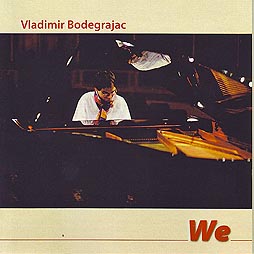 History of the album We, musical with working title Nubian Dancer, is intriguing. Composer Vladimir Bodegrajac started it when he lived outside his native country, Croatia. So, he wrote all lyrics in English, which makes his songs even more international (they are already international concerning the universality of love story he is telling to his listeners). But it seems that the language was an obstacle to further distribution of the music: one of the eminent Croatian theatres rejected to produce the musical. Finally, We was published by Croatian Association of Music Theorists, whose president Tihomir Petrovic became music editor and the producer of this CD.
I learned about musical content of the album We during one of Petrovic’s famous lectures on musical form. Petrovic is musician who teaches musical theory in Music School Vatroslav Lisinski in Zagreb, is also the lecturer on Rock academy and the author of numerous books on theory of music. He regularly holds workshops at Croatian Musical Institute where he talks about interesting topics such as symbolic of numbers in music of Johann Sebastian Bach, or comparisons between classical works and popular songs concerning their harmonies, melodies and form. And these are only few of Petrovic’s activities.
My point is: Petrovic is not musician who would promote musical work of mediocre quality. In his introduction to compact disc We, he wrote: “Could music be popular, which means that is accepted by broad, especially young public, and, at the same time, great, which is proved by professional analyze of all its components; and even more, could it, at the same time, be beautiful and attractive? Truth to say, this description usually matches only rare exceptions. So, it is a joy to present an opus of young Croatian composer Vladimir Bodegrajac whose work can truly be described by words “popular” and “great”. The quality of his compositions comes from specific combination of classical harmony and counterpoint with the modern musical expression which respects laws of creating musical form presented by lied from classical periods of musical history.”
These characteristics of music written by Vladimir Bodegrajac made me to write this review for Klasika. Music of We clearly comes from popular domain and its genre is clearly theatre musical. But, besides conventions of musical, Bodegrajac also uses conventions of classical domain: during listening of songs, their instrumental introduction doesn’t show that the music which follows doesn’t come from contemporary classical music language. Only the voice enables the composer to naturally slide in popular musical genre which is obviously meant for broad public, not only to closed circles of classically educated musicians. Without doubt, Bodegrajac aims to all the listeners, especially to music lovers.
We has classical beginning: the song of the same name is introductory in its character and brings lyrical atmosphere which is going to start dramatically events of the love story. Among many beautiful numbers are Touch Code and Woman in Bed which do not only bring out very strong emotions, but their music idea is exceptionally solved by using twisted, unordinary solutions in harmony and melody. Nevertheless, for the story are very important songs Nubian Dancer, Vortex and Confession which approach to musical lyric in special way and find new modes of creating by now so much standardized institution of love song.
Composer wanted very much that his love songs are taken seriously that he decided to “ask for help” from the “old master” who was, during history of music, inspiration and role model to many famous composers. Citation of motive B-A-C-H (with which great Johann Sebastian signed his compositions many times) isn’t accidental, nor is composer’s whim, but is part of thinking that musical content is as important as textual content. The author of both layers, that is, the music and the lyrics, is Vladimir Bodegrajac. He is, at this disc, also the only performer: he plays piano and sings (main voice and the back vocals). Because of this, listener doesn’t have realistic picture of musical, but listens to its projection which doesn’t have orchestral colors, colors of different voices, of choir and other elements which are usually part of richer musical productions. But the picture-projection which Bodegrajac and his producer offer to public is quite enough for listener to conclude that this is exceptional art work which succeeds to find a balance between (usually often on the opposite sides) classical and popular musical language. This is true crossover and it doesn’t wear make up of propaganda, of stardom of interpret(s) and/or author(s) and of clumsy attempts for popular genre to sound like classical or vice versa. Congratulations to Vladimir Bodegrajac!
© Irena Paulus, KAZALISTE.hr, June 13, 2011.
Piše:
 Irena
IrenaPaulus